
Combat
Sooner or later something with teeth is going to object to your existence. This page is everything worth knowing before it does — how fights start, what the buttons do, and why the rat is glaring at you like that.
Engaging Enemies
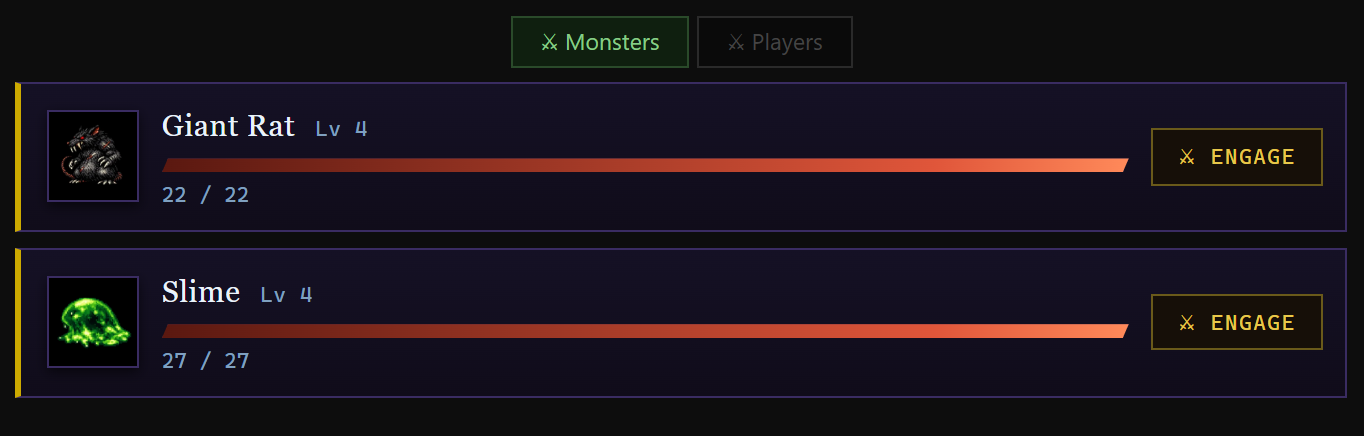
Wilderness tiles spawn enemies automatically. Enemy cards appear on the left of the game panel showing the enemy's name, level, and remaining HP. Click ⚔ Engage on an enemy card to begin the fight.
Difficulty Colours
Enemy names are colour-coded to indicate how dangerous they are relative to your level:
- Green — Enemy is significantly weaker. Low risk.
- Amber — Close to your level. Moderate risk.
- Red — Enemy is significantly stronger. Proceed with caution.
Combat Actions
Once in a fight you have four actions:
- ⚔ Attack — A physical strike using your equipped weapon and Strength.
- ✦ Cast — Use an equipped spell. Costs MP. Uses Intelligence.
- ⚡ Weapon Arte ▾ — A finishing technique fuelled by Tactical Points. Opens a dropdown of every Arte available to your equipped weapon. See Tactical Points & Weapon Artes.
- ✦ Ability ▾ — Class-defining buffs and powers on long real-time cooldowns. Every class has a handful — the shelf was trimmed to the abilities that change a fight and then widened again in Patch 4.8 to 94 across the realm. See Class Abilities.
Combat continues turn by turn until either you or the enemy is defeated. Defeating an enemy awards EXP and Gold. There is no Flee option in PvE — commit carefully.
Blocking, Dodging and Evasion
Three different things stand between an enemy and your health bar. They are separate systems, they stack, and they resolve in this order.
- Dodge — a flat percentage roll from class traits, Support Class, Attunements, Apotheosis, Class Mastery and Ascendant nodes. If it lands, the attack misses outright — this is the only one of the three that can make a blow do nothing at all, which is why it is the one that is capped. Every source adds together at full value up to 35%; past that each further point is worth less than the last, easing toward 50% without ever reaching it. Nothing you buy is wasted, and nothing makes you untouchable.
- Evasion (Dexterity) — your Dexterity against the enemy's Accuracy decides whether they connect. At equal stats an enemy hits about 75% of the time. This is bounded: no amount of Dexterity pushes an enemy’s physical attacks below a 35% hit chance (20% for their spells), and none lets them exceed 85%. Dexterity is not a dodge stat and it does not add to your Dodge percentage.
- Block (shields) — if the blow lands, an equipped shield gets a chance to turn part of it aside. Block reduces damage; it never deletes it.
Shield Block
Any shield in your left hand blocks. How often, and how much it turns aside, depends on the shield's armour class and its rarity — not on its armour value.
| Shield type | Block chance Common → Dark Crystal | Damage turned aside |
|---|---|---|
| Heavy — kite shields, bulwarks, bastions | 14% – 26% | 55% |
| Light — bucklers and round shields | 20% – 32% | 30% |
| Cloth — spellwards and barriers | 10% – 22% | 40% |
A heavy shield blocks rarely and eats most of the blow; a buckler blocks often for less. Rarity raises how often you block but never how much is absorbed, so a Legendary buckler is still a buckler. Every shield's exact figures are printed on its item card.
Shields occupy the left hand, so blocking costs you a two-handed weapon or a second one-hander. That is the trade.
Opening a Fight
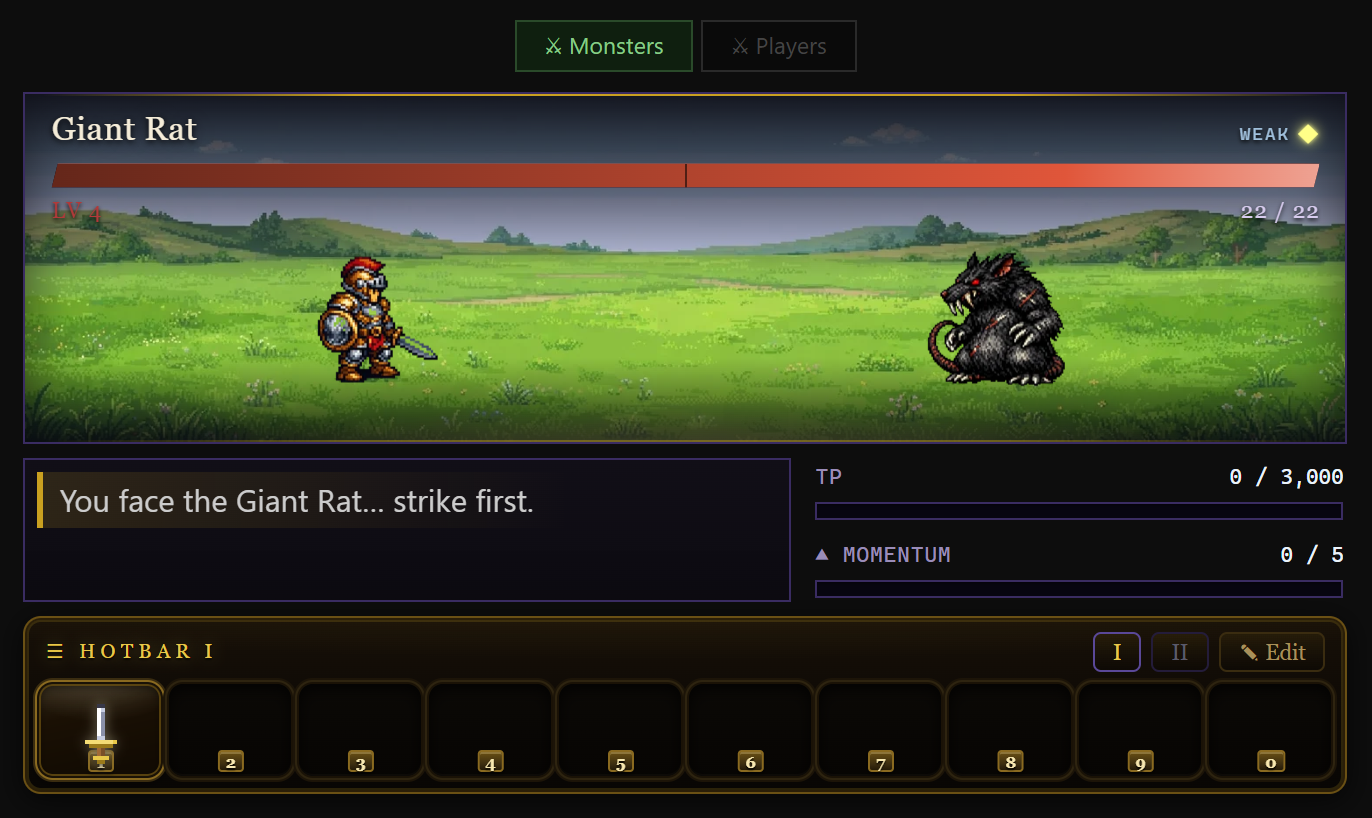
You don't have to lead with a basic swing. Your configured Attack and Cast hotkeys (defaults F and R) both initiate combat — so a caster can step onto a foe and open with a spell, while the encounter card stays clean with just a Fight button.
How Damage Is Calculated
Your damage scales from the stat behind the action — Strength for physical attacks and Weapon Artes, Intelligence for spells — together with your weapon's power, and is then reduced by the target's Defence. Enemy defence genuinely matters: a heavily-armoured foe shrugs off far more than a fragile one.
The curve is level-stable. It's tuned so a well-geared character takes roughly 2–3 hits to fell an on-level normal enemy at any level, instead of one-shotting low foes and stalling on high ones. Better gear still makes you hit harder — it just no longer trivialises the world.
The same maths governs enemies striking you, so high-level foes — especially casters — are a real threat. Keep your Defence up (and Spirit, which blunts incoming magic), and watch your HP.
Critical Hits
Weapons have a Crit Chance and Crit Multiplier. A critical strike deals significantly increased damage. Higher-tier weapons generally have better crit stats.
Spell Damage — Tile and Day Bonuses
Cast spells receive stacking damage bonuses if they line up with the world — the tile you stand on and the day's element:
- Tile Bonus — an elemental affinity tile (e.g. casting Fire on a Volcanic tile) modifies your spell's damage by the tile's listed percentage.
- Day-of-Week Bonus — if your spell's element matches the current Crystaria day, the cast gains an additional +15 %. See Time, Days & Moons for the day → element table.
Both bonuses stack additively before damage is rolled. A Fire spell cast on a Fire-affinity tile during Pyrenday gets both the tile and the +15 % day bonus.
Weapon Skill XP
Every successful hit with a weapon awards Weapon Skill XP toward that weapon's typeclass. Normal hits give 10 XP; critical hits give 20 XP. The combat log shows your XP gain and current progress on every hit, with a highlighted message whenever your skill level increases. See the Weapon Skills section for full details.
Lifesteal & Manasteal
Lifesteal returns HP as a share of the physical damage you deal; Manasteal does the same for MP. Both come from bound Essences, class traits and a handful of abilities, and both fire on weapon attacks, Weapon Artes and Magic alike.
Leech is designed to sustain you through a fight, not top you off between them. Any recovery drawn from damage you deal stops once you reach 75% of your maximum HP — and the same ceiling applies to MP. Below that line leech works at full strength; at it, further leech simply does nothing.
And no single hit can return more than 2% of your maximum. However much lifesteal you carry, one blow recovers at most that share of your HP, and manasteal the same share of your MP. This is the limit most built characters actually meet: once your damage grows larger than your own health pool, the share of it your lifesteal would return is already past the cap, so further lifesteal beyond that point adds nothing to what a hit gives back. The 25% figure quoted for Vampiric essences is a share of the damage you deal, not of your health, and the recovery ceiling above still applies on top of both.
Death Knights and Necromancers — the two classes built around draining the living — carry a higher ceiling of 90%, as a matter of class identity.
Enemy AI
Up to four enemies can occupy a tile at once. They do not move between tiles, but new enemies spawn over time — a tile with 0 or 1 enemies populates aggressively, a tile with 2 or 3 populates more slowly, and a tile that has reached four stops spawning until you thin the field. Enemies left idle too long despawn naturally.
Casters, the Hotbar and Fusion
Magicians, Warlocks and Necromancers strike 25% harder with damage spells than the spell’s numbers alone would give — the trade for Dual Cast, which no longer exists. Every action above also lives on the two-bar Hotbar, and two mastered spells of a kind can be cast together as a Spell Fusion.